
Direct Answer
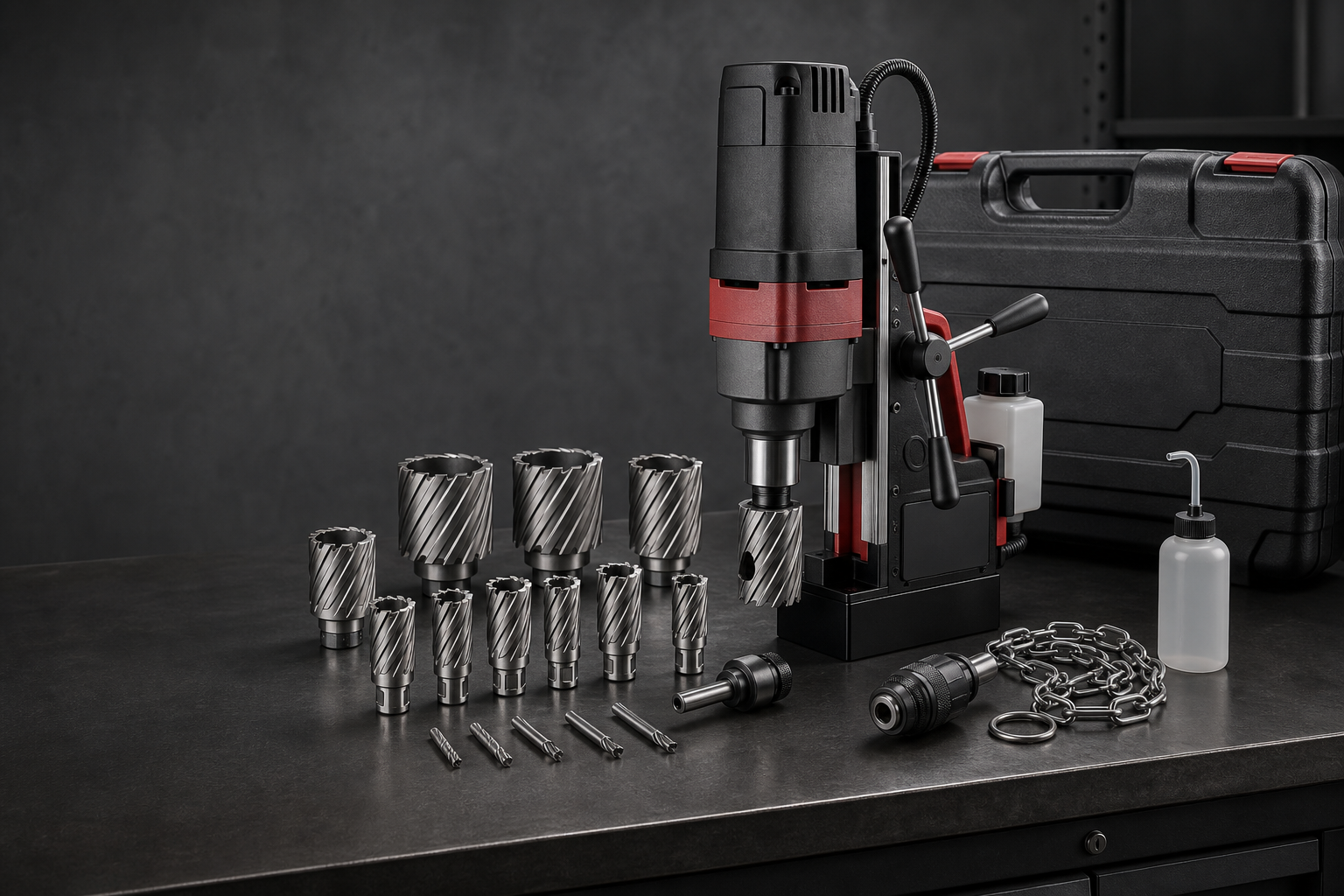
For large holes in beams and plate, use a magnetic drill with annular cutting capacity above the required diameter, adequate torque at low speed, stable magnetic contact and sufficient stroke for the cutter depth. Match the annular cutter, pilot pin, arbor, speed and cutting fluid as one system.
Define the Hole Before Choosing the Machine
Record the finished diameter, cutting depth, material grade, plate thickness, tolerance, number of holes and working position. A machine that can drill one maximum-size hole is not automatically suitable for repeated production at that diameter.
For regular high-load work, allow capacity margin. If most holes are close to a machine’s stated maximum, a larger machine class may provide better torque, rigidity and duty-cycle margin.
Why Annular Cutters Are Efficient
An annular cutter removes a ring and produces a centre slug. A twist drill removes the entire cross-section. For large diameters, the annular method normally reduces the volume of metal removed and can shorten cutting time.
HSS cutters offer toughness and may be resharpened. TCT cutters can support higher productivity in stable conditions but are more sensitive to shock and chatter.
Machine Selection Factors
Cutting Capacity
Confirm both diameter and depth. Cutter length, pilot pin and available machine stroke determine whether the complete tool can pass through the workpiece.
Torque and Speed
Large cutters normally run at lower speed. Confirm that the gearbox delivers usable torque in the required range. Do not compare motor wattage alone.
Magnetic Holding Conditions
Clean the steel beneath the base. Check thickness, flatness, coating, corrosion and base overhang. Large cutting loads make a stable magnetic setup especially important.
Machine Weight and Access
Heavy-duty machines provide capacity but can be harder to position on beams or elevated structures. Balance capacity with handling, clearance and working position.
Recommended Cutting Process
- Inspect and stabilise the workpiece.
- Clean the magnetic contact area.
- Fit the correct cutter and pilot pin.
- Attach the safety chain or strap.
- Verify adhesion before starting the motor.
- Select speed according to cutter and material guidance.
- Apply suitable cutting fluid.
- Feed smoothly and monitor chips and motor load.
- Reduce feed before breakthrough.
- Stop, isolate and remove the hot slug safely.
Avoiding Premature Cutter Failure
Common causes include incorrect speed, interrupted feed, insufficient coolant, blocked flutes, spindle runout, poor magnetic contact and excessive pressure. Blue chips, squeal, vibration or a slowing motor indicate that the process should be stopped and reviewed.
Factory Testing for B2B Orders
A useful test record states the steel type and thickness, hole diameter, cutting depth, cutter material, speed setting, lubrication and result. Shipment inspection can also verify voltage, motor running, magnet function, slide movement, accessory quantities and packaging.
Request a model match: Send the largest hole, depth, steel grade, daily quantity, voltage and working position to FERROVANTA.
FAQ
What magnetic drill size is needed for an 80 mm hole?
Use a model approved for at least 80 mm annular cutting under the stated conditions, with the correct low-speed torque and cutter connection. For repeated 80 mm work, additional capacity margin may be preferable.
Can a twist drill make the same hole?
It may be possible with a suitable machine and staged process, but an annular cutter normally removes less material for a large through-hole.
Why does the machine move during a large cut?
Possible causes include poor surface contact, thin steel, excessive feed, cutter chatter, base overhang or an unstable workpiece. Stop immediately and correct the setup.
How deep can an annular cutter drill?
Common cutter families cover several depths, but machine stroke, arbor and pilot pin must also be compatible.
Should I choose HSS or TCT?
Choose by material, setup stability, speed, duty cycle, operator experience and cost per completed hole.
Conclusion
Large-hole drilling is primarily a system-selection problem. Define the hole and workpiece, then choose capacity, torque, magnetic stability and tooling with enough margin for the real duty.
Get a Model Recommendation: Contact FERROVANTA for a machine, cutter and inspection proposal.