Introduction
Private labelling a magnetic drill involves more than applying a logo to an existing machine. The distributor becomes responsible for how the product is positioned, documented, supported and represented in the target market.
A dependable OEM programme should align:
- Product capacity and market demand.
- Electrical configuration.
- Machine and cutter compatibility.
- Testing and shipment inspection.
- Labels, manuals and packaging.
- Compliance documentation.
- Spare parts and warranty handling.
- Batch traceability and change control.
The short answer is: approve the product system and the support process before approving the artwork.
This checklist is designed for industrial tool importers, regional distributors, catalogue brands and procurement teams evaluating a magnetic drill manufacturer. It avoids unsupported claims and focuses on documents and test evidence that can be reviewed before an order.
1. Define the Target Market Before Selecting Models
Begin with the market, not the factory catalogue.
Document:
- Target countries.
- Main customer segments.
- Common steel applications.
- Normal and maximum hole diameters.
- Preferred voltage and frequency.
- Acceptable machine weight.
- Expected retail price position.
- Required warranty period.
- Distributor service capability.
A European steel fabricator, a Middle East MRO contractor and a Southeast Asian industrial reseller may prioritise different capacities, plugs, documentation and packaging.
Avoid launching too many overlapping models. A clear opening range might include:
- Compact machine for installation and light fabrication.
- Professional 40–50 mm machine for general structural steel.
- Heavy-duty 60–80 mm machine.
- Multi-function model when tapping or variable-speed work is commercially justified.
The range should also include compatible HSS or TCT cutters, pilot pins, arbors and common spare parts.
2. Create a Written Product Requirement Specification
A quotation is not a complete product specification. Create a controlled requirement sheet for every model.
Include:
- Product code and revision.
- Maximum annular cutting diameter.
- Maximum twist-drill diameter.
- Cutting depth and stroke.
- Rated input power.
- No-load speed or speed range.
- Magnetic adhesion test condition.
- Voltage, frequency and plug.
- Cable length.
- Machine and packed weight.
- Dimensions.
- Included accessories.
- Safety restraint.
- Transport case.
- Label language.
- Manual language.
- Packaging standard.
State which values are nominal and which are acceptance limits. For example, input wattage printed on a label is not the same as measured cutting output. Avoid writing inspection criteria that cannot be measured consistently.
3. Evaluate the Manufacturer’s Product Knowledge
A capable supplier should ask application questions rather than immediately recommend the largest machine.
Useful supplier questions include:
- What material will be drilled?
- What are the normal and maximum diameters?
- What cutting depth is required?
- How many holes are expected per shift?
- Will the machine work vertically or overhead?
- Are annular cutting, twist drilling or tapping required?
- Which voltage and frequency apply?
- Which cutter shank and pilot pin system is preferred?
Ask the supplier to explain model differences in practical terms. A strong answer connects capacity, speed, torque, magnetic force, weight and duty. A weak answer repeats a data sheet without addressing the customer requirement.
4. Review Factory Capability Without Overclaiming
“Factory” can describe manufacturing, assembly or final packaging. Clarify what is performed in-house and what is outsourced.
Review:
- Incoming inspection for motors, gears, magnets, switches and castings.
- Assembly instructions.
- Torque control for critical fasteners.
- Electrical safety testing.
- Functional testing.
- Cutting test capability.
- Calibration status of inspection equipment.
- Non-conforming product process.
- Batch and serial traceability.
- Packaging and warehouse controls.
If an on-site audit is not possible, request a live video walkthrough focused on the actual process. Pre-recorded promotional footage is useful for orientation but should not replace document review.
Do not claim a quality system certification unless the certificate is current, covers the relevant legal entity and scope, and can be verified.
5. Approve Samples in the Intended Configuration
The sample should be as close as possible to the production configuration.
Confirm:
- Correct voltage and frequency.
- Intended plug and cable.
- Proposed colour and surface finish.
- Label position and content.
- Accessories and transport case.
- Manual draft.
- Compatible cutter and arbor.
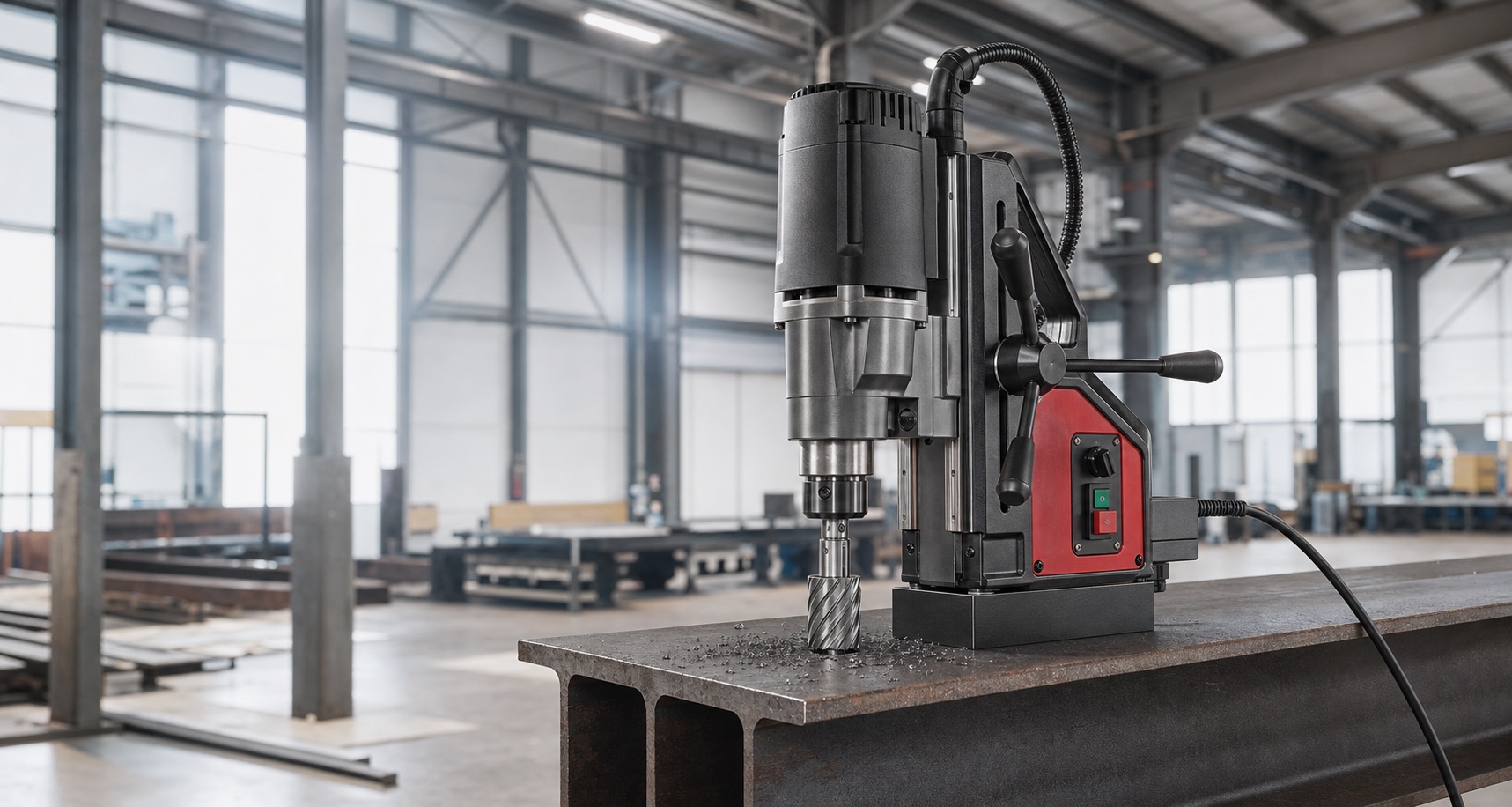
Sample Test Plan
A practical sample plan can include:
- Visual and dimensional inspection.
- Magnet function on a defined clean steel plate.
- Switch and interlock checks.
- No-load rotation and abnormal sound observation.
- Slide travel and adjustment.
- Cutting test using a documented cutter, material, diameter and depth.
- Cable and strain-relief inspection.
- Temperature observation during repeated cuts.
- Accessory fit check.
- Packaging drop or transport simulation when required.
Record the conditions. A sample that drills “one hole in steel” provides less information than a test report identifying material, thickness, cutter, speed, coolant and result.
6. Separate Factory Testing from Marketing Claims
Factory testing should answer whether a product conforms to the agreed specification. Marketing claims answer why a customer should buy it. Mixing the two creates risk.
Examples:
- Testable: “The sampled machine completed the agreed 50 mm × 30 mm annular cutting test in the specified steel coupon without abnormal stop.”
- Not sufficiently defined: “Cuts faster than all competitors.”
- Testable: “Magnet function was checked on the agreed steel plate.”
- Not sufficiently defined: “Maximum safety.”
Do not publish universal hole-count or cutting-time claims unless the conditions are fully defined and repeatable.
7. Confirm Electrical and Market Configuration
Global distribution requires more than changing a plug.
Check:
- Rated voltage.
- Frequency.
- Plug type.
- Cable specification.
- Switch and control compatibility.
- Label values.
- Manual values.
- Carton marking.
Ask whether the motor or electrical components differ between voltage versions. A machine designed around one market configuration should not be relabelled without engineering confirmation.
Compliance obligations vary by market. Engage an appropriate compliance professional or laboratory to determine applicable directives, standards, testing and documentation. A supplier declaration should not be treated as legal advice.
8. Build the Machine and Cutter Range Together
Customers need a working system. For every machine model, prepare a compatibility matrix:
| Item | Questions to confirm |
|---|---|
| Annular cutters | HSS/TCT, diameter range, cutting depth, shank |
| Pilot pins | Diameter family, length, coolant function |
| Arbor | Connection, retention screws, coolant feed |
| Twist drill chuck | Maximum diameter and adapter |
| Tapping attachment | Model compatibility, thread range, reverse |
| Coolant system | Reservoir, hose, seals, working position |
| Safety restraint | Chain/strap specification and attachment |
| Spare parts | Brushes, switches, cables, seals and common wear parts |
This matrix reduces returns and improves distributor sales training.
9. Approve Branding and Packaging Carefully
Private-label artwork should include only verified claims.
Review:
- Brand logo.
- Product model.
- Electrical rating.
- Required safety markings.
- Serial or batch identification.
- Manufacturer/importer details where required.
- Country-of-origin statement where applicable.
- Warning labels.
- Manual reference.
Packaging Review
International transport can damage a machine that passed factory testing. Confirm:
- Internal support around the machine.
- Protection for handles, cable and control panel.
- Separation of cutters and sharp accessories.
- Moisture protection.
- Case closure.
- Outer carton strength.
- Pallet and stacking method.
- Barcode and shipping marks.
Request pre-production packaging photographs before mass printing.
10. Define Pre-Shipment Inspection
Agree on inspection before production begins, not after cartons are sealed.
The inspection plan should state:
- Lot size.
- Sampling level.
- Critical, major and minor defect definitions.
- Documents and equipment required.
- Functional tests.
- Cutting test sample quantity.
- Packaging checks.
- Acceptance and rework process.
Recommended Inspection Areas
Quantity and identity
- Correct model and version.
- Serial/batch records.
- Correct accessories.
Workmanship
- Coating and casting condition.
- Fastener security.
- Slide movement.
- Cable and connector condition.
Function
- Magnet switching.
- Motor start/stop.
- Speed control and reverse where applicable.
- Coolant function.
- Abnormal noise or vibration.
Documentation
- Rating labels.
- Manual.
- Warranty information.
- Packing list.
Packaging
- Case and carton.
- Drop protection.
- Correct market labels.
Shipment inspection is a sampling activity and does not prove every unit is defect-free. The goal is to apply agreed evidence and escalation rules.
11. Plan Spare Parts and Warranty Handling
Before launch, define:
- Warranty scope.
- Exclusions.
- Claim evidence.
- Response time.
- Repair or replacement decision.
- Spare-parts stock.
- Parts diagrams.
- Service instructions.
- Escalation contact.
Common service items may include carbon brushes, switches, cables, seals, coolant components and fasteners, depending on the machine. The distributor should know which repairs can be completed locally and which require factory support.
Ask how design changes will be communicated. A replacement switch or motor must remain compatible with the sold product revision.
12. Establish Change Control
One of the largest OEM risks is an unapproved component change after sample approval.
The supply agreement should require notification before changes to:
- Motor.
- Gear components.
- Magnet assembly.
- Switches or electronics.
- Power cable.
- Casting.
- Bearings.
- Paint or finish.
- Accessories.
- Packaging.
- Sub-supplier.
Define whether a new sample, test report or written approval is required. Maintain a golden sample and signed specification revision.
13. Prepare Sales and Technical Content
Before shipment, build:
- Accurate product page.
- Specification table.
- Machine/cutter compatibility chart.
- Operating manual.
- Quick-start guide.
- Safety information.
- Product photographs.
- Packing list.
- Spare-parts list.
- FAQ.
- Sales training notes.
For Google SEO and AI search, use clear statements and defined conditions. Avoid unsupported superlatives such as “best,” “safest” or “never fails.”
14. Commercial Terms Beyond Unit Price
Compare:
- Minimum order quantity.
- Sample cost.
- Artwork and packaging charges.
- Tooling or mould charges.
- Lead time.
- Payment terms.
- Incoterm.
- Spare-parts allowance.
- Inspection cost.
- Warranty reserve.
- Reorder lead time.
- Forecast flexibility.
The lowest unit price can produce the highest total cost if packaging, quality control, service parts or documentation are weak.
15. Use a Pilot Order to Verify the Complete Process
After sample approval, a controlled pilot order can reveal issues that one engineering sample cannot show. The objective is not merely to receive a smaller shipment. It is to verify that production, inspection, documentation, packing and communication work together at a repeatable scale.
Define pilot-order goals before placing the purchase order:
- Confirm that production units match the signed sample and specification.
- Verify serial or batch identification.
- Test the approved inspection plan.
- Check that all accessories are packed consistently.
- Review carton markings and pallet configuration.
- Record transit damage, if any, after arrival.
- Confirm that spare parts and documents arrive with the shipment.
- Collect feedback from the distributor’s technical and sales teams.
When the pilot shipment arrives, quarantine the cartons until incoming inspection is complete. Select samples across different pallet and carton positions rather than taking only the most accessible unit. Photograph carton condition before opening, then record product identity, accessories, function and cosmetic condition.
If the pilot order exposes a problem, separate containment from corrective action. Containment addresses the affected shipment; corrective action addresses why the issue occurred and how recurrence will be prevented. Require evidence before scaling the next order.
16. Define the Evidence Required at Each Approval Gate
An OEM project becomes easier to control when each stage has a clear approval record.
| Approval gate | Minimum evidence |
|---|---|
| Model selection | Application requirement and model comparison |
| Technical specification | Signed revision-controlled specification |
| Sample approval | Test record, photographs and approved sample |
| Branding approval | Signed label, manual and packaging artwork |
| Production release | Purchase order and approved bill of materials/configuration |
| Shipment release | Inspection report, packing list and corrective actions closed |
| Reorder | Change confirmation and field feedback review |
Store the evidence under consistent model and revision names. Email conversations alone are difficult to audit when staff, suppliers or model versions change.
For AI-assisted content and online product pages, use the same approved specification as the source of truth. This prevents a marketing page, PDF catalogue and carton label from showing conflicting capacity, weight or electrical information.
17. Measure the Supplier Relationship After Launch
Supplier evaluation should continue after the first shipment. Track practical indicators such as:
- On-time sample and shipment performance.
- Inspection pass rate.
- Field claim rate by model and batch.
- Response time for technical questions.
- Spare-parts fulfilment time.
- Corrective-action closure time.
- Frequency of unapproved changes.
- Documentation accuracy.
Use consistent definitions. A field claim is not automatically proof of a manufacturing defect, and a low claim count can be misleading if reporting is incomplete. Review the failure description, operating condition, photographs, serial number and returned parts where appropriate.
A professional supplier should be willing to discuss patterns rather than treat every claim as an isolated event. The distributor should also provide structured evidence instead of forwarding incomplete customer messages. This shared discipline improves product decisions and protects both parties.
Mid-Article CTA
Planning a private-label magnetic drill range?
Send FERROVANTA your target market, capacity range, voltage, estimated quantity and brand requirements. We can prepare a model and documentation checklist for discussion.
CTA button: Discuss Your OEM Project
FAQ
What is the usual MOQ for private-label magnetic drills?
MOQ depends on model, colour, labels, packaging and component changes. Simple logo/packaging programmes generally require less volume than engineered product changes. Request a written quotation.
Should I order a sample before mass production?
Yes. Approve a sample in the intended electrical, accessory and branding configuration, then retain the signed sample and specification for comparison.
What should a magnetic drill factory test?
At minimum, check identity, electrical function, magnet operation, motor operation, slide movement, accessories and packaging. Add documented cutting tests and repeated-cycle checks based on purchase risk.
Can the supplier provide CE or other compliance documents?
Ask for documents relevant to the exact model and legal entity, then have applicability and validity reviewed for the target market. Do not assume one certificate covers every configuration.
How should warranty claims be handled?
Define evidence, response times, parts availability, repair authority and replacement rules before launch. Record serial or batch information.
What information is required for an OEM quotation?
Provide target market, models/capacities, voltage/frequency, plug, colour, logo, packaging, manual languages, quantity, inspection requirements and expected launch schedule.
How can a distributor reduce quality risk?
Use a signed product specification, approved sample, change-control clause, pre-shipment inspection plan, documented test conditions and clear corrective-action process.
Conclusion
A magnetic drill OEM programme is successful when the product, tooling, documentation, inspection and support process are approved as one system.
Begin with customer requirements. Convert them into a controlled specification. Test the sample under defined conditions. Verify the factory process without relying on promotional claims. Approve compliant artwork and packaging. Inspect shipments against agreed criteria. Finally, maintain spare parts, warranty and change control after launch.
Final CTA
FERROVANTA TOOLS CO., LTD. supports magnetic drill, annular cutter and accessory range planning for global B2B buyers. Send your market, capacity, voltage, quantity and private-label requirements to start a structured OEM discussion.
Primary CTA: Contact Us
Secondary CTA: Ask for Product Catalog
---
Image Plan
Image 1
- Purpose: OEM hero image.
- Insert position: Below H1.
- Caption: “A reliable private-label programme aligns product, testing, documentation and packaging.”
- ALT text: “Magnetic drills prepared for private label OEM review in an industrial tool factory”
- AI image prompt: “Photorealistic premium B2B industrial scene, multiple professional magnetic drills arranged at a clean OEM product review table, neutral placeholder label areas with no readable branding, specification sheets and packaging samples nearby, modern tool factory, graphite black and deep red palette, no text, 16:9”
Image 2
- Purpose: Factory testing.
- Insert position: After sample test plan.
- Caption: “Sample approval should use documented material, cutter size, speed and acceptance criteria.”
- ALT text: “Factory acceptance test of a private label magnetic drill on structural steel”
- AI image prompt: “Documentary photo inside industrial tool quality lab, technician in PPE conducting factory acceptance cutting test on magnetic drill and structural steel coupon, checklist, digital caliper and test labels visible but unreadable, clean organized station, realistic chips, no logos, 16:9”
Image 3
- Purpose: Production and inspection.
- Insert position: In pre-shipment inspection.
- Caption: “Pre-shipment inspection verifies sampled machines, accessories, documents and packaging.”
- ALT text: “Quality inspector checking magnetic drills before international shipment”
- AI image prompt: “Photorealistic pre-shipment quality inspection in magnetic drill factory, inspector checking control panel and serial label on sampled machines, rows of finished tools and cases, professional warehouse lighting, international B2B manufacturing, no readable text or logos, 16:9”
Image 4
- Purpose: Packaging and logistics.
- Insert position: After packaging review.
- Caption: “Transport packaging must protect the machine, cable, controls and accessories.”
- ALT text: “Private label magnetic drill packaging prepared for export shipment”
- AI image prompt: “High-end industrial export packaging scene, magnetic drill secured inside rugged carrying case with foam support, accessories separated, private label carton mockups with blank brand panels, pallets ready for shipment, clean warehouse, photorealistic, no readable text, 16:9”
Image 5
- Purpose: Distributor partnership and trust.
- Insert position: Before conclusion.
- Caption: “Clear specifications and change control support long-term distributor relationships.”
- ALT text: “International distributor and magnetic drill factory team reviewing product specifications”
- AI image prompt: “Professional international B2B meeting inside industrial tool showroom, diverse distributor representatives and factory engineers reviewing magnetic drill specifications and product sample, collaborative serious atmosphere, premium documentary photography, no readable logos, 16:9”
CTA and Popup Plan
Mid-Article CTA
- Position: After “Define Pre-Shipment Inspection.”
- Headline: “Need a structured OEM requirement sheet?”
- Body: “Share the target market, models, voltage, packaging and order quantity. We will prepare the questions needed for a technical quotation.”
- Button: “Discuss Your OEM Project”
- Destination:
/contact
End CTA
- Position: After conclusion.
- Headline: “Build a magnetic drilling range for your market.”
- Buttons: “Contact Us” / “Ask for Product Catalog”
- Destination:
/contact
Popup
- Trigger: 50% scroll or 45 seconds; desktop exit intent; maximum once per seven days.
- Title: “Planning a Private-Label Magnetic Drill Range?”
- Description: “Send your target market and capacity range. FERROVANTA will respond with an OEM preparation checklist.”
- Fields: Name, Email and Phone required; Company; Target market; Estimated quantity.
- Submit button: “Request OEM Information”