
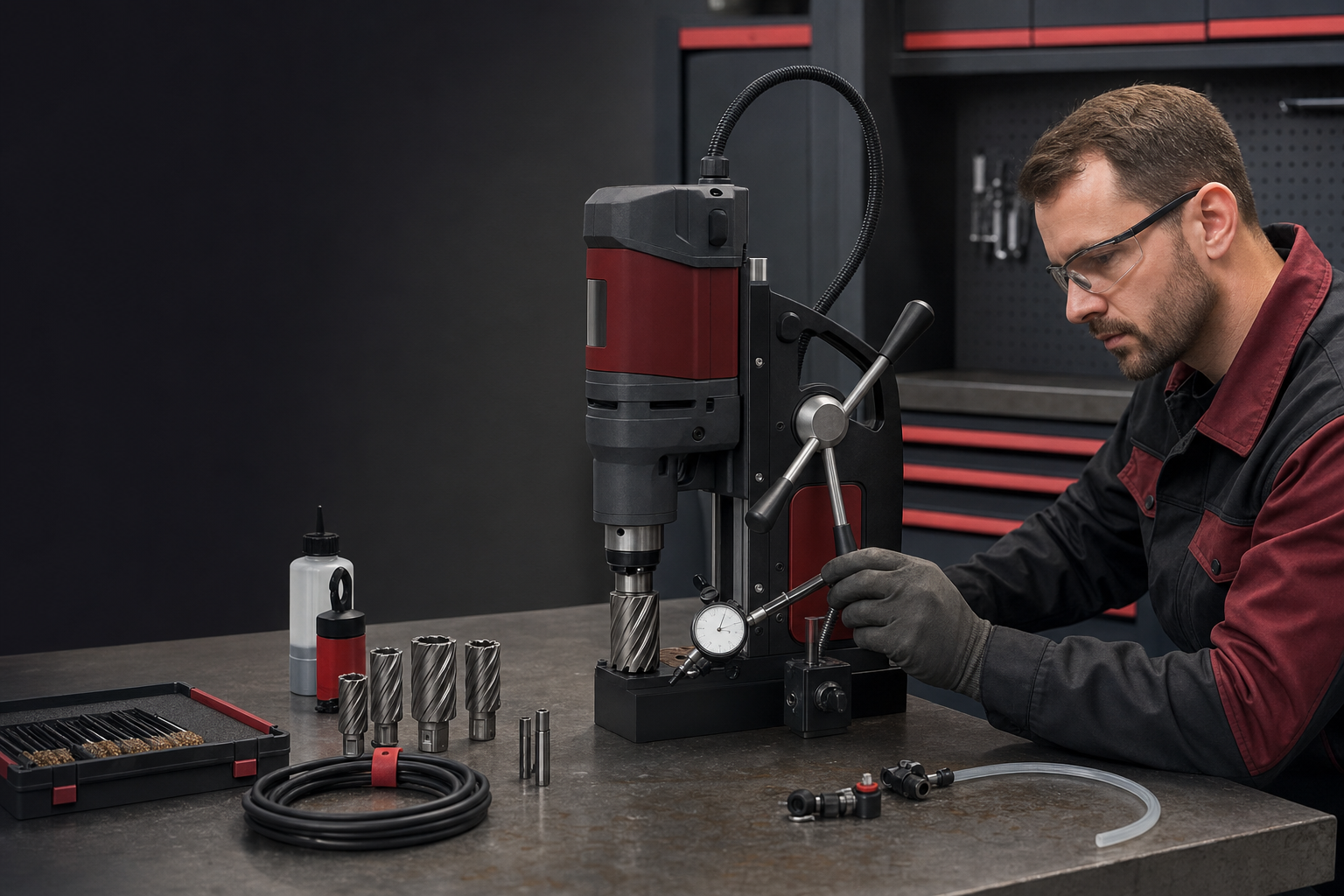
Quick Diagnostic Answer
When a magnetic drill performs poorly, stop the cut and diagnose the system in this order: workpiece and magnetic contact, cutter condition and compatibility, spindle and arbor, speed and feed, coolant delivery, electrical supply, then motor or control components. Replacing the cutter without checking the base and spindle can hide the real cause.
Disconnect the machine before inspection. Electrical and internal repairs should be completed by qualified personnel using the correct parts and service information.
Daily Maintenance
After each shift:
- Disconnect power and allow the machine and cutter to cool.
- Remove chips from the magnetic base, slide, spindle area and coolant passages.
- Wipe the magnetic contact surface clean and check it for burrs or impact damage.
- Inspect the cable, plug, switch covers and strain relief.
- Check cutter teeth, pilot pin movement and retaining screws.
- Drain or secure coolant where required for transport.
- Store the machine dry in its case with the slide protected.
Do not blow conductive chips into vents or electrical assemblies. Use a controlled cleaning method appropriate to the machine manual.
Weekly and Periodic Checks
Usage intensity determines the interval. A rental fleet or multi-shift fabricator needs more frequent inspection than an occasional maintenance team.
Check slide adjustment, arbor condition, spindle runout, fasteners, handles, coolant tank and hoses. Inspect carbon brushes where applicable and replace them as a set according to service limits. Review the magnetic base cable and internal connections only through authorised service procedures.
Keep a simple service record with serial number, date, operating hours if known, observed fault, replaced parts and test result. This is valuable for distributors managing warranty decisions and recurring field problems.
Troubleshooting by Symptom
The Magnetic Base Feels Weak
Possible causes:
- Thin workpiece.
- Paint, scale, rust, chips or oil under the base.
- Curved or uneven contact.
- Partial base overhang near an edge.
- Low or unstable supply voltage.
- Damage to the base, cable, rectifier or control circuit.
First move the machine to a clean, flat steel test plate of suitable thickness and compare performance. If adhesion remains abnormal, isolate the machine and arrange qualified inspection. Do not compensate with excessive feed pressure.
The Cutter Chatters or Breaks Teeth
Check:
- Is the magnet fully seated?
- Is the safety restraint installed without pulling the machine out of alignment?
- Are the arbor and spindle clean and tight?
- Is the cutter damaged or incorrectly mounted?
- Is speed appropriate for cutter diameter and material?
- Is feed smooth rather than intermittent?
- Is coolant reaching the cutting edge?
- Is the workpiece stable?
TCT teeth are particularly sensitive to impact and chatter. HSS may tolerate more shock, but repeated vibration will still shorten life and affect hole quality.
The Motor Slows or Overheats
Common causes include an overloaded cutter, excessive feed, blunt teeth, incorrect speed, undersized extension cable, voltage drop, blocked ventilation or a motor/service fault.
Stop and allow the machine to cool as instructed. Confirm cable rating and supply voltage under load. Never bypass overload protection. If heat or smell persists during a normal test cut, remove the machine from service.
Coolant Does Not Reach the Cut
Inspect fluid level, tank vent, hose, valve, arbor passage and pilot pin. Dried fluid or chips can obstruct the system. The pilot pin must move freely. Use compatible cutting fluid and clean the system before long-term storage.
For vertical and overhead work, use the lubrication approach approved for that position. Gravity-feed coolant can move toward the motor if the setup is wrong.
Holes Are Oversize, Tapered or Rough
Potential causes include spindle runout, arbor wear, a damaged cutter, loose slide adjustment, unstable magnetic contact, incorrect feed or chip recutting. Measure the cutter and test the machine on a controlled sample before blaming the workpiece.
The Slug Does Not Eject
Stop the spindle and isolate power. Check the pilot pin, spring movement, cutter depth and chip packing. Never place fingers under a rotating cutter or strike the slug while the machine can start.
Maintenance for International Distributors
A strong after-sales programme requires more than a warranty statement. Recommended service assets include:
- Exploded drawings and part numbers.
- Model-specific brush, switch, cable, arbor and coolant-kit lists.
- Fault intake form with photos and video.
- Standard test plate and test-cut procedure.
- Serial or batch traceability.
- Clear rules for field replacement versus return inspection.
For shipment inspection, record the voltage label, switch sequence, magnet function, no-load running sound, spindle movement, slide travel, accessories and packaging. For agreed samples, a controlled test cut provides better evidence than an unstructured demonstration.
Need a service-ready product range? Ask FERROVANTA for the recommended spare-parts package for your order quantity, voltage market and planned warranty model.
Preventing Problems Before They Reach the Customer
During production and final inspection, recurring issues can be reduced by defining customer requirements early:
- Correct plug and voltage configuration.
- Cutter and arbor compatibility.
- Manual language and warning labels.
- Included safety restraint.
- Transport protection for the slide and base.
- Spare-parts list by model.
- Sampling level and functional test method.
Avoid unsupported claims such as a fixed cutter life or universal maximum adhesion. Document the conditions of any test: steel type, thickness, cutter diameter, depth, fluid, speed and operator method.
FAQ
How often should a magnetic drill be serviced?
Follow the model manual and adapt the interval to usage, environment and inspection findings. High-duty, dusty or rental applications need shorter intervals.
Why does my magnetic drill move during cutting?
Likely causes include poor contact, thin steel, coating, chips, an uneven surface, excessive feed or a base that is not fully supported. Stop immediately and correct the setup.
Can I lubricate the slide with any grease?
Use the lubricant and adjustment procedure specified for the machine. Excess or unsuitable lubricant can retain abrasive chips.
When should an annular cutter be replaced?
Remove it from service when teeth are chipped, cracked, missing, excessively worn or unable to cut correctly after setup variables are verified. Qualified resharpening may be possible for some cutters.
What spare parts should a distributor stock?
The answer depends on model and sales volume. Common service items may include brushes, switches, cables, arbors, pilot pins, coolant components and fasteners.
Conclusion
Reliable magnetic drill maintenance is a repeatable diagnostic process, not random part replacement. Clean contact, correct tooling, stable power and documented inspection resolve many field issues before a major repair is needed.
Ask for Parts and Support: Send FERROVANTA the model, serial or batch reference, voltage, fault description, photos and a short operating video for an efficient initial assessment.