
Direct Answer
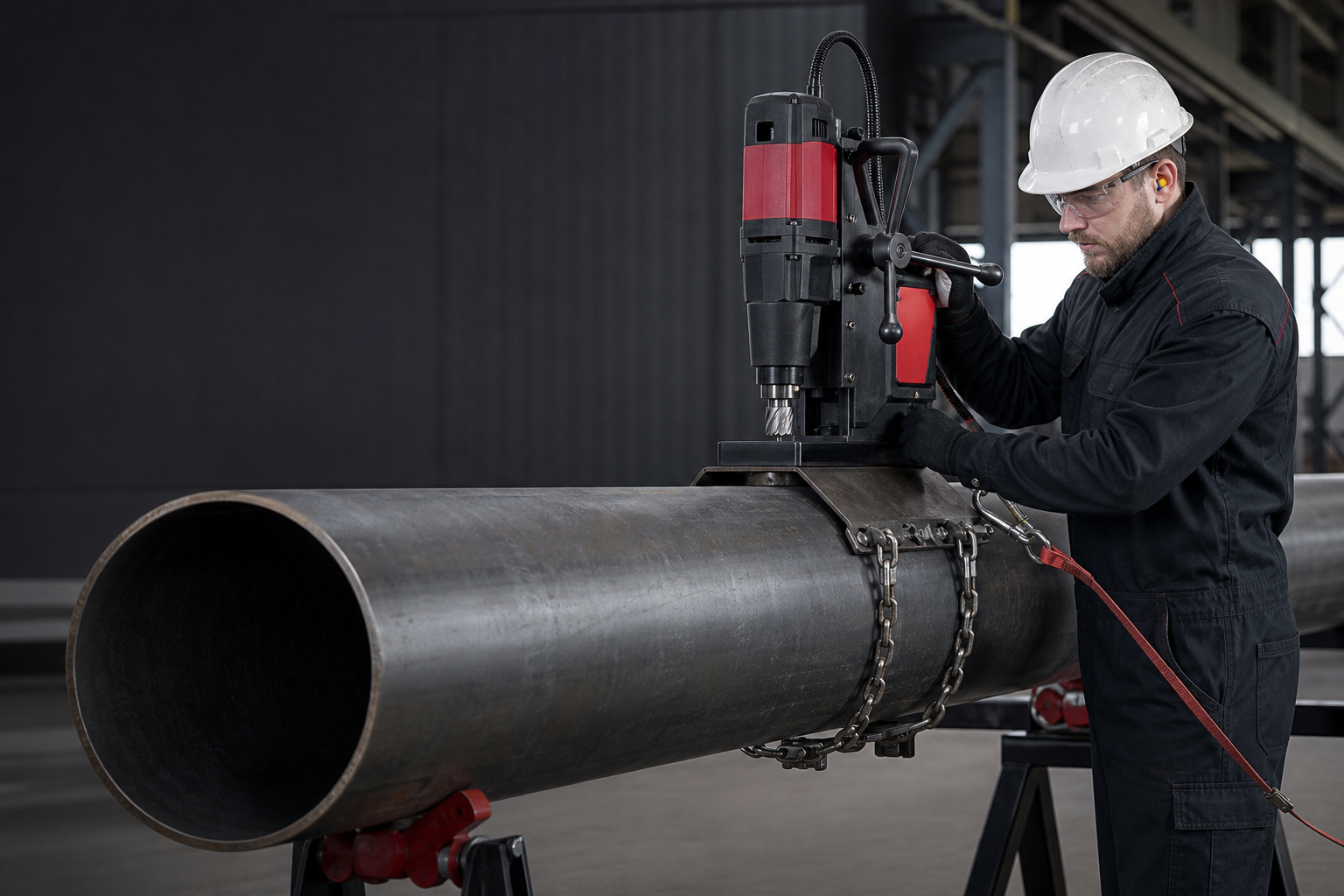
Do not place a standard flat magnetic base directly on a small curved pipe and assume it is secure. Use a machine and engineered pipe fixture approved for the diameter and orientation, stabilise the workpiece, install a secondary restraint, verify the complete setup without the motor running, then test the cutter, speed, feed and lubrication under controlled conditions.
Pipe drilling is an application-engineering task. The machine manual, fixture instructions and site risk assessment take priority over general guidance.
Why Curved Steel Changes the Setup
A magnetic base develops useful holding force when its contact surface is close to clean ferromagnetic steel. On a curved pipe, only part of a flat base may touch. The air gap reduces the effective magnetic circuit and can allow the machine to rock.
Additional variables include:
- Pipe outside diameter and wall thickness.
- Material grade and magnetic response.
- Whether the pipe is fixed, empty and isolated.
- Surface coating, corrosion and welds.
- Hole position and working orientation.
- Internal contents, pressure and hazardous-area rules.
- Cutter breakthrough and slug control.
Never drill a live, pressurised or inadequately isolated line.
Pipe Fixture Options
Chain-Clamp Pipe Adaptor
A purpose-designed frame or saddle is secured around the pipe with chains. The magnetic drill mounts to a flat plate on the fixture. The adaptor must fit the pipe diameter and be tightened according to its instructions.
Fabricated Work Platform
For repeat industrial work, an engineered platform may be designed for a defined pipe range. It should be reviewed by a competent person and include restraint, alignment and load requirements. An improvised loose plate is not an acceptable substitute.
Permanent Workshop Fixture
When pipe sections are processed before installation, a fixed jig or drilling station may be safer and more productive than field magnetic drilling.
Application Planning Checklist
1. Define the Pipe
Record outside diameter, wall thickness, grade, coating and whether it is installed or loose. Confirm the line is isolated and safe to drill.
2. Define the Hole
Specify diameter, cutting depth, quantity, tolerance and location relative to welds, ends and other features. Check whether the slug can fall inside and how it will be recovered.
3. Select the Machine
Consider machine weight, physical height, stroke, cutter capacity, speed control and handle access. A low-profile model may help where clearance is limited, but the fixture must still provide secure mounting.
4. Select Cutter and Pilot Pin
Choose a cutter compatible with material, depth, machine and arbor. Pipe breakthrough can be an interrupted transition as the cutter crosses the curved wall, so stability and controlled feed are important. Do not publish a universal feed or RPM without the cutter and material data.
5. Plan Lubrication
Coolant must reach the cutting edge without entering the motor, contaminating the pipe or creating a slip hazard. The correct method changes with orientation.
6. Install Secondary Restraint
Secure the machine and fixture so neither can fall or rotate if holding force is lost. Establish an exclusion zone for chips, hot slug and equipment movement.
Controlled Operating Sequence
- Isolate, depressurise and verify the pipe according to site procedure.
- Clean the fixture contact area.
- Install and inspect the approved pipe fixture.
- Mount the magnetic drill and attach the secondary restraint.
- Check alignment and clearance for handles, cutter and slug.
- Energise the magnet where required and test stability with the motor off.
- Apply the approved cutting fluid.
- Start the motor and feed smoothly.
- Reduce feed near breakthrough and monitor for chatter.
- Stop, isolate and control the hot slug before removing the machine.
If the fixture shifts, chain tension changes, the machine rocks or the cutter chatters, stop immediately.
Cutter Choice for Pipe
HSS can be useful where toughness and a more forgiving edge are priorities. TCT can support productivity in a stable, well-controlled setup but is less tolerant of impact. Selection also depends on material hardness, diameter, depth and availability of the correct machine speed.
For repeated orders, conduct a sample test using the customer’s pipe specification or a representative sample. Record the cutter, machine, speed setting, lubricant, time and observed wear. This is more credible than promising a fixed number of holes.
Typical Applications
- Pipeline construction and maintenance after proper isolation.
- Structural tubular fabrication.
- Handrails and frames.
- Shipbuilding and offshore fabrication.
- Machinery and process skids.
- Large cylindrical tanks where an engineered mounting solution is used.
Each industry may impose additional permit, hazardous-area, contamination or traceability requirements.
Have a pipe drilling project? Send FERROVANTA the outside diameter, wall thickness, material, hole size, orientation, voltage and site constraints for a configuration review.
Procurement and Shipment Inspection
For a pipe application package, the purchase specification should identify:
- Magnetic drill model and voltage.
- Approved fixture and pipe range.
- Cutter sizes and depths.
- Pilot pins and arbor.
- Secondary restraint.
- Coolant method.
- Operating and inspection documents.
- Packaging that prevents fixture or base damage.
During shipment inspection, confirm accessory quantities, fixture fit and fasteners. Functional tests should use defined conditions and agreed samples. Branding on delivered products and images should match the approved FERROVANTA artwork; third-party logos should not appear.
FAQ
Can a normal magnetic drill attach directly to a pipe?
A flat base usually cannot make full contact with a curved surface. Use an approved pipe fixture or another engineered method.
What is the minimum pipe diameter?
It depends on the fixture, drill, base dimensions and pipe stability. Use the fixture manufacturer’s stated range and verify the complete setup.
Can I drill a pressurised pipe?
Do not drill a live or pressurised line. Isolation and verification must follow the owner’s procedure and applicable rules.
Is a low-profile magnetic drill better for pipe?
It may improve access in limited clearance, but does not remove the need for a suitable fixture, restraint and stable workpiece.
How do I stop the slug from falling into the pipe?
Plan slug control before drilling. The acceptable method depends on pipe access, cleanliness requirements and process risk.
Conclusion
Successful pipe drilling depends on an engineered interface between the machine and the curved workpiece. Secure fixture design, line isolation, controlled cutting and verified accessories matter more than nominal motor power.
Ask for a Configuration: Send your pipe and hole data to FERROVANTA TOOLS CO., LTD. for a machine, fixture and cutter recommendation.