Direct Answer
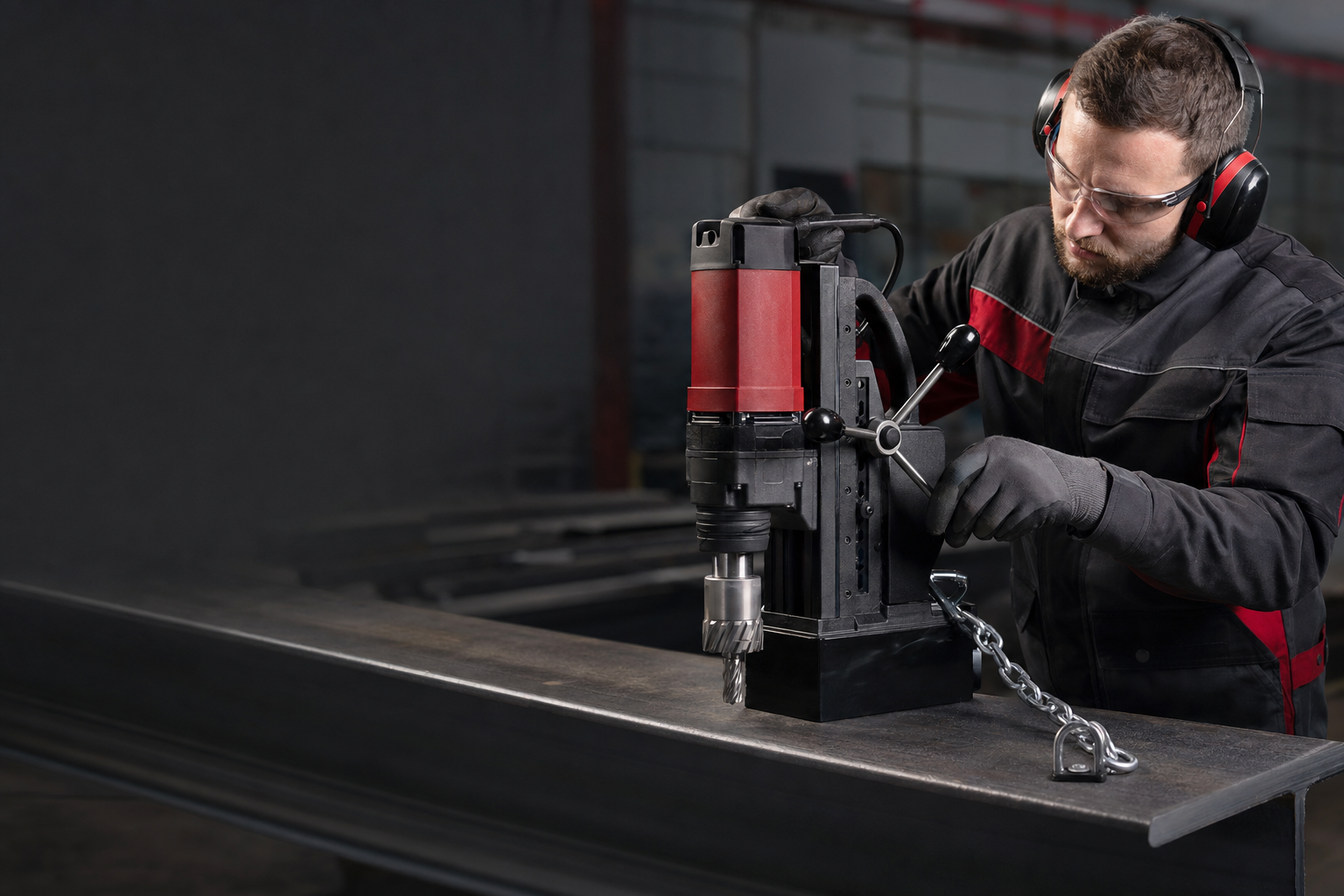
Choose a magnetic drill for structural steel by matching the largest hole diameter and depth, material thickness, work position, available clearance, daily hole volume and power supply. Compact machines suit installation and maintenance; professional 40–50 mm machines cover general fabrication; heavy-duty models support larger holes and higher load.
Common Structural Steel Jobs
- Beam and column connection holes.
- Base plates and stiffeners.
- Bridge and railway maintenance.
- Shipbuilding and offshore fabrication.
- Machinery frames and process skids.
- On-site modification and repair.
The best machine changes with access. A workshop can accommodate a heavier model, while an elevated or restricted site may prioritise low weight or low-profile height.
Selection by Application
General Fabrication
A professional machine with approximately 40–50 mm annular cutting capacity, suitable speed range and common cutter connection covers many beam and plate jobs.
Large Beams and Heavy Plate
Higher-capacity machines provide larger cutter range, lower-speed torque and additional rigidity. Confirm that the steel surface fully supports the magnetic base.
Installation and Maintenance
Portability, handles, cable management, case protection and quick setup can be as important as maximum capacity.
Restricted Clearance
A low-profile magnetic drill may fit beneath flanges or inside confined structures. Check total working height with the cutter fitted, not only the machine body height.
Vertical and Overhead Work
Use a machine approved for the position, a suitable safety restraint, controlled lubrication and an exclusion zone. Machine weight becomes a major handling factor.
Specifications That Matter
| Specification | Why it matters |
|---|---|
| Annular cutting capacity | Maximum cutter diameter |
| Cutting depth | Workpiece thickness and cutter reach |
| Speed range | Compatibility with diameter and material |
| Motor and gearbox | Torque under cutting load |
| Magnetic force | Holding potential under defined test conditions |
| Weight and height | Handling and access |
| Spindle/arbor | Cutter and accessory compatibility |
| Voltage/frequency | Destination-market operation |
Workpiece Conditions
Magnetic force depends on material response, thickness, flatness and cleanliness. Coatings and air gaps reduce contact. The base should not overhang an edge. Curved pipe requires an approved fixture rather than direct flat-base contact.
Buyer Information Checklist
Send the supplier:
- Steel grade or description.
- Plate or section thickness.
- Maximum hole diameter and depth.
- Holes per shift or project.
- Horizontal, vertical or overhead position.
- Available working height.
- Voltage and plug.
- Required cutters, case and spare parts.
Send a drawing or site photo: FERROVANTA can use it to review access, capacity and tooling requirements before quotation.
FAQ
What size magnetic drill is best for steel fabrication?
A 40–50 mm professional machine covers many general jobs, but the correct size must be based on the buyer’s largest regular hole and duty.
Can a magnetic drill work on an I-beam?
Yes, when a flat area fully supports the base and the steel condition provides adequate adhesion. Avoid base overhang.
Can it drill through painted steel?
Paint creates a gap and may reduce holding force. Surface preparation must follow the machine instructions and project coating requirements.
Is variable speed necessary?
It is valuable for mixed cutter diameters, materials, countersinking or tapping. Fixed speed may be sufficient for a narrow repeatable range.
What accessories should be ordered?
At minimum, select compatible cutters, pilot pins, arbor, safety restraint and cutting fluid. Add chuck, tapping adaptor, pipe fixture or spares only when required.
Conclusion
Structural steel selection should start with the real job, not a model name. Hole range, access, steel condition and daily duty lead to a more reliable purchase.
Compare FERROVANTA Models: Send your application data for a practical recommendation.