Direct Answer
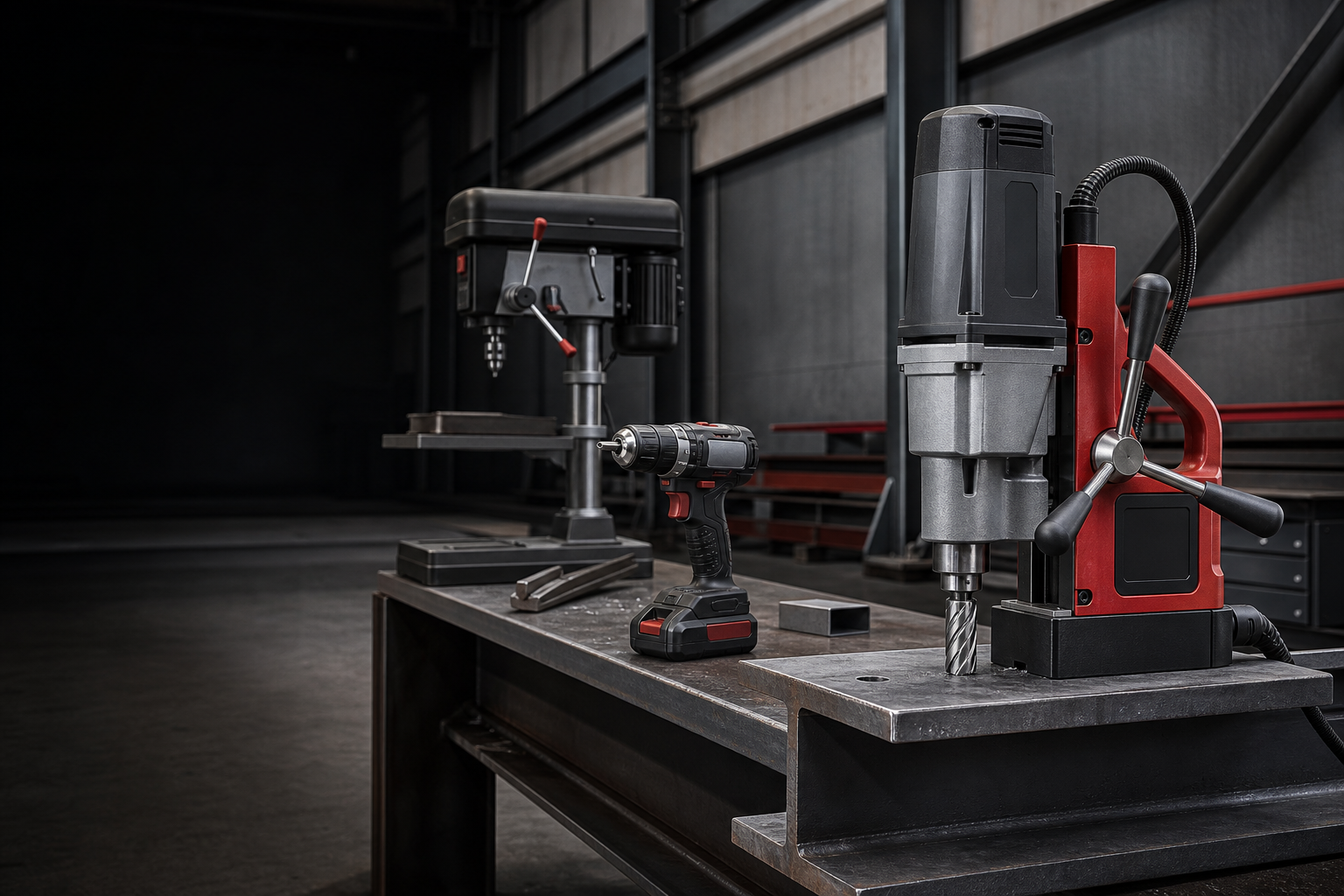
Choose a magnetic drill when large, accurate holes must be made in ferromagnetic steel at the worksite or on a structure that cannot be moved. Choose a handheld drill for smaller, lighter-duty holes where portability and access matter most. Choose a fixed drill press when parts can be brought to a controlled workshop and repeatable alignment, fixtures and continuous bench production are priorities.
The three tools overlap, but they solve different workholding problems.
Comparison Table
| Decision factor | Magnetic drill | Handheld drill | Fixed drill press |
|---|---|---|---|
| Portability | High | Highest | Low |
| Workholding | Electromagnetic base on suitable steel | Operator controlled | Table, vice or fixture |
| Typical strength | Large holes in installed steel | Small holes and general tasks | Controlled workshop drilling |
| Annular cutter use | Primary application | Limited/specialised | Possible with correct setup |
| Vertical/overhead work | Possible with approved setup and restraint | Possible within tool limits | Generally not applicable |
| Setup sensitivity | Surface and magnet contact | Operator control | Fixture and alignment |
| Best buyer | Fabricator, erector, maintenance team | General trade and service | Workshop/production cell |
When a Magnetic Drill Is the Best Choice
A magnetic drill brings the spindle to the steel. The base holds the machine in position while an annular cutter removes a ring of material. This is useful for beams, plate, bridges, machinery, shipbuilding, repair and structural assembly.
Advantages include:
- Portable large-hole capability.
- Reduced material removal with annular cutters.
- Accurate positioning on installed steel.
- Options for flat, vertical and overhead work when approved.
- Less dependence on moving a large workpiece.
Limitations include the need for a suitable ferromagnetic contact surface, adequate material thickness, surface preparation and a secondary restraint. Aluminium, many stainless grades, curved pipe and heavily coated surfaces require a different fixture or drilling method.
When a Handheld Drill Is Better
A handheld drill is simple and highly mobile. It suits smaller holes, pilot holes, light fabrication, installation and repair where the operator can safely control torque and alignment.
It becomes less attractive as hole diameter and material thickness increase. The operator carries the reaction force, and maintaining perpendicularity can be difficult. Large twist drills remove the full hole cross-section and can require substantial torque.
Do not assume a higher-wattage handheld drill becomes equivalent to a magnetic drill. The missing element is stable workholding.
When a Drill Press Is Better
A drill press is effective when the workpiece fits the table and can be clamped securely. The rigid column, adjustable table, spindle travel and repeatable fixture make it suitable for workshop production.
It may provide:
- Repeatable positioning with jigs.
- A controlled feed and work height.
- Broad tooling options.
- Easier integration into a production cell.
Its main limitation is that the work must come to the machine. Long beams, installed structures and field repairs may be impractical to position.
Accuracy and Hole Quality
Accuracy depends on the entire setup. A magnetic drill can produce clean, round holes when the base is stable, the spindle has low runout and the cutter is correctly used. A drill press can be highly repeatable with proper fixtures. A skilled operator can achieve good results with a handheld drill, but alignment variation is normally greater.
For customer evaluations, define the test:
- Steel type and thickness.
- Hole diameter and depth.
- Tool and cutter condition.
- Position and surface condition.
- Measurement method.
- Acceptable diameter, roundness and finish.
One demonstration hole is not a universal accuracy guarantee.
Productivity and Cost
Compare total process time rather than machine price:
- Moving and clamping the workpiece.
- Marking and positioning.
- Drilling cycle.
- Tool changes.
- Deburring.
- Rework and rejected holes.
- Operator handling.
A magnetic drill can save time when the alternative is transporting or repositioning a large steel assembly. A drill press may win in a fixture-based batch. A handheld drill may be most economical for a few small holes.
Selection Questions for B2B Buyers
- Is the steel already installed?
- Is the contact surface magnetic, flat and sufficiently thick?
- What are the maximum hole diameter and depth?
- How many holes are required per shift?
- Is work horizontal, vertical or overhead?
- Are annular cutters, twist drills, countersinking or tapping required?
- What voltage and plug are needed?
- Does the buyer need service parts, training and private-label packaging?
FERROVANTA can align factory testing and shipment inspection with the selected tool and application. For example, a magnetic drill order may include functional checks, accessory fit, sample cutting, label verification and carton inspection according to agreed requirements.
Still comparing options? Send a drawing or describe the hole range, steel thickness, work position and production volume. FERROVANTA can recommend whether a magnetic drill is technically appropriate.
FAQ
Is a magnetic drill more accurate than a handheld drill?
It can provide more stable alignment on suitable steel because the base holds the machine. Final accuracy still depends on setup, cutter, spindle and operator.
Can a magnetic drill replace a drill press?
It can replace some operations on large or installed steel, but a fixed press remains better for many fixture-based workshop tasks.
Can a magnetic drill use normal twist drills?
Some models accept a chuck or adaptor within specified capacity. Confirm speed, spindle, stroke and tool compatibility.
Which tool is best for large holes in steel beams?
A suitable magnetic drill with an annular cutter is often efficient because it can be positioned directly on the beam. The surface and safety setup must be verified.
Does a magnetic drill work on stainless steel?
Only if the material provides adequate magnetic attraction or an approved alternative fixture is used. Stainless grades vary.
Conclusion
The correct choice is determined by workholding and workflow. Magnetic drills bring controlled large-hole capability to steel structures; handheld drills maximise access for lighter tasks; drill presses maximise workshop control.
Compare Magnetic Drills: Contact FERROVANTA with your application data for a product and tooling recommendation.